


Life Link III Provides Patient Transport, Care, and Safety to the Marshfield Area and Beyond
Thursday, June 4th, 2026 -- 12:01 PM
(AI assisted transcription of interview via Otter.ai)
Riley: "Life Link III has been providing patient transport, care, and safety since its formation in 1985."
"It was one of the first nonprofit consortiums in the country to transport critically ill patients by helicopter. The company has always focused on clinical excellence and is an early adopter in bringing new technology to critical care."
"Today, Life Link III operates eleven helicopter bases located throughout Minnesota and Wisconsin. Helicopter and airplane services are available 24/7, providing on-scene emergency response and inter-facility transport."
"Life Link III’s transportation services are accredited by CAMTS (Commission on Accreditation of Medical Transportation Systems), ensuring the highest standards of quality and safety are met on every transport."
"I was invited to Life Link III’s Marshfield base and had the opportunity to speak with Luke Stoflet, Senior Manager, Partner Engagement & Strategy of Life Link III, and he discussed the program in more detail. I also spoke with Ryan Stauff, Chief Development Officer with Life Link III, and he provided some background information as well."
Luke: "So, Life Link III came to the Marshfield area in 2018 when we partnered with the health system here. They had a need for transport services and we recognized that and helped answer that call. Life Link III has been around since 1985, so we've been in existence for over 40 years now."
"Our mission is to provide safe and effective air medical transport on board every aircraft. We obviously have a pilot, a nurse, and a paramedic, partnered with nine different health systems. Now we just provide transport services for them, independent nonprofit on our own, a 501(c)3."
"Each of these different health systems buy into this service and then we, again, provide the transport services for them. We do normal adult patient type transports from inter-facility, hospital to hospital, or from the scenes of accidents as well, but we also provide NICU transport for five different NICU teams, which is pretty unique."
"Carry a lot of different equipment on board. We're really proud to serve this area and continue to be a partner for all the different public safety agencies, the area health systems, and just be a key resource in the community here."
Riley: "And you provide other services too. Just recently, I believe, you guys helped out with, in Clark County, there was an individual that walked away from a local health care facility and you actually helped with that search and rescue."
Luke: "Yeah, so we provide, we call it search and assist, we provide that resource to the area partners as well, just as another tool, right? We don't have infrared on board, or FLIR, that a lot of people would think of, but we have the advantage, obviously, of height."
"All of our crew members wear night vision goggles at night time and then we have a big searchlight on board. Yeah, so I got the call that night from the emergency manager of Clark County saying, 'Hey, would you guys be willing to do this?'"
"We consult with all of our leaders to make sure that, yes, we can safely do that. Come out and help out however we can. So, it's just something we provide to the community. There's no fee occurred to anyone on that."
"One thing is we don't want to look for those that don't want to be found. You know, wanted subjects or anyone running from the law, we're not going to come help with, but, you know, individuals with memory issues, lost children, hunters, stuff like that, we help out with pretty regularly and we're proud to provide that."
Riley: "Do you know off the top of your head about how many calls you respond to per year?"
Luke: "So, each base responds to about 400 calls a year, but you could say, on average, it's two a day. Then, when we say they do, we're talking completed about 400 a year. When you compare them across all of our bases, we've got 11 bases of operation and then an airplane as well. That's based in the Minneapolis area, but serves the entire upper Midwest. Do you have anything to add, Ryan?"
Ryan: "Yeah, so, as we mentioned, we've been here since 2018; in the Wisconsin market since 2007 and, you know, with those bases, we're at 24/7 operation and, you know, serving the community. About 80% of what we do is inter-facility transport, so taking someone from one level of care to another."
"And then as we kind of head into the summer months here, which we call summer trauma season, obviously more people are are out and about and so, sometimes, those on scene emergencies do occur, so we'll land on the side of the road or in a safe space and help coordinate with ground services to extract an individual and get them to definitive care destination."
"And so as we serve the area, we're paying attention to the dynamics of rural health and as bricks and mortar facilities are strained and specialties are leaving certain areas, the demand for our services increases."
"Not only because of our ability to get patients to different areas very quickly, but also because of the level of care that we provide, equipment that we have on board, everything from point of care lab testing to ultrasound technology, we carry."
"Blood and plasma products, all of these things are investments that we make. They are not things that are reimbursed by insurance, but we do that for the best outcome of the patient and to really maintain the continuum of care that exists within our hospital systems and across the region."
Riley: "I see they're kind of doing some work, some checks on the helicopter. Is that kind of a daily thing that they do here?"
Luke: "Yeah, so every morning, or at every shift change, the pilots will go around doing a pre-flight check on the aircraft, so just checking for like the normal things like you should on your vehicle, right? We don't check tire pressure necessarily, but we check lots of other things on board the aircraft to ensure that it's mission ready, and we're ready to go at a moment's notice, because, as Ryan had said, we provide 24/7 coverage."
"The pilots, they do 12 hour shifts, some of our crews do 24 summer twelves, but still providing that full coverage. We've got two main maintenance technicians, or maintainers, at every base location, too, so four pilots, two main maintenance personnel, and 10 clinicians in total, five nurses, five paramedics at every base."
"And then, before every flight, too, they'll do a little bit quicker version of a pre-flight check again, just making sure everything's where it should be, nothing's dangling that shouldn't be, and getting ready. This morning, they were doing tail rotor inspection."
"We have to do certain maintenance at certain time frames on it, kind of like you do mileage on a vehicle for an oil change, it's time on an aircraft, so after so much time, we have to do these certain checks, so there's kind of finishing that up here, they'll do hover check and a power check, once that's done, maybe a maintenance flight, continue on from there."
Riley: "I also spoke with Carly Butt, a registered nurse and one of the EMTs on Life Link III, and she gave me a tour of the helicopter and their supplies as well as the services provided, which can include NICU transport."
"Life Link III even has the capacity to carry blood for patients who may be in need and, overall, they can do many of the services provided in hospitals including running blood tests and acquiring important patient information from hospitals ahead of time."
She also discussed the challenge of working in that environment including tight quarters and even connectivity issues depending on the areas they may have to land in. She also mentioned that, as opposed to working in a regular hospital, you don’t always have as many hands as you may need while providing care to a patient."
"Carley stated that nurses and EMTs that work on the helicopter do go through special training to work in that environment. She also stressed how much she enjoys helping others and working on the Life Link III and the unique opportunities it provides in her career.
"I also spoke with Casey Colby, a pilot of Life Link III, and he discussed how he became involved with the program. How long have you been a pilot?"
Casey: "10 years, something around there."
Riley: "What led you to pilot for Life Link III?"
Casey: "Just knowing some people in the program that recommended it. They moved here a year or two before I did and said they had a great relationship and things you look for in a company are their safety record, and how those pilots are, if they're ever questioned on the decisions they make, and it always seemed very safety oriented, according to my friends. And then that's what it is, that's what it's been since I've been here."
Riley: "Casey also provided some facts about the helicopter as well as the various safety checks that are performed from day to day and before and after each flight. He also touched on some of the other services they provided including instances of search and assist for missing individuals."
"Life Link III is the first and only Critical Care Air Medical Transport Program to achieve an AACN Beacon Award for Excellence Gold. If you’d like to support Life Link III, or just learn more, you can head to their website (https://lifelinkiii.com/) and click on the donate button."
"You can also donate by signing up for the Life Link III Golf Scramble being held at the Keller Golf Course in Maplewood, Minnesota this year on September 29th."
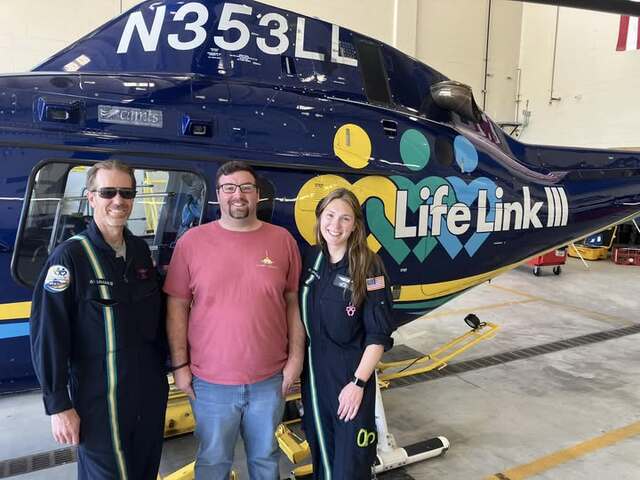
(Pictured from left to right: Casey Colby (Pilot), Riley Hebert (WDLB News Director), and Carly Butt (Registered Nurse/EMT))
Feel free to contact us with questions and/or comments.